
Restore vital blood flow to your heart instantly. Consult Dr. Anshu Kabra for life-saving Complex Coronary Angioplasty and the expert management of severe arterial blockages.
Schedule an Angiography
Coronary artery disease develops when cholesterol plaque builds up inside the arteries, restricting blood flow to the heart muscle. If left untreated, this leads to a massive heart attack. Do not ignore these symptoms:
A squeezing, heavy pressure, or burning sensation in the center of the chest. The pain may radiate to your left arm, neck, jaw, or back.
Struggling to breathe or catching your breath during physical exertion, climbing stairs, or experiencing unexplained, sudden fatigue.
Breaking out in a sudden cold sweat, accompanied by unexplained nausea, lightheadedness, or severe indigestion-like symptoms.
Coronary Angioplasty (also known as Percutaneous Coronary Intervention, or PCI) is a life-saving procedure designed to open narrowed or blocked blood vessels supplying the heart.
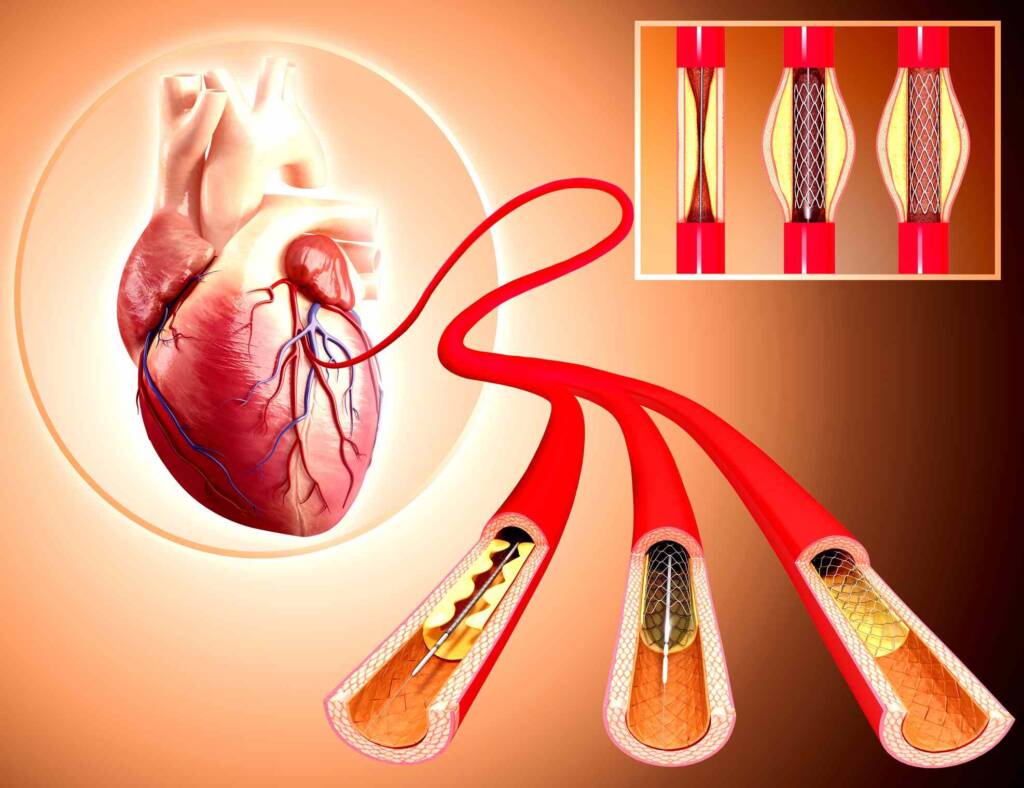
Under local anesthesia, a thin catheter is guided to the heart. Special contrast dye is injected, allowing Dr. Kabra to pinpoint the exact location and severity of the blockages via real-time X-ray.
A specialized catheter equipped with a tiny, deflated balloon is navigated directly into the blockage. The balloon is gently inflated to compress the plaque against the artery walls, widening the pathway.
A small wire mesh tube (stent) is permanently placed at the site to act as a scaffold, keeping the artery wide open. Blood flow is instantly restored to the starving heart muscle.
When treating the heart, volume speaks to safety. Dr. Kabra has successfully performed over 20,000+ Coronary Angiographies and 7,500+ Coronary Angioplasties.
He is a recognized expert in treating Complex Triple Vessel Disease. For severely hardened, calcified arteries that standard balloons cannot open, he utilizes advanced techniques like Rota-ablation to safely drill through the plaque, ensuring successful stent placement even in the most difficult anatomical scenarios.
"I suffered a massive heart attack at 2 AM. I was rushed to Narayana Hospital. Dr. Kabra performed an emergency angioplasty and placed two stents. His speed and precision saved my life that night. He is truly the best angioplasty doctor in Jaipur."
— Suresh G., Jaipur"I had three severe blockages and was told I needed open-heart bypass surgery. Dr. Kabra reviewed my angiogram and successfully treated my complex triple vessel disease using advanced stenting techniques. I avoided bypass surgery entirely and was home in two days."
— Anil K., Vaishali NagarLeave your details below. Our clinic coordinator will contact you to arrange a priority consultation with Dr. Kabra.